Negative Pressure vs Vacuum Degree: Core Differences in Pressure Measurement

June 17, 2026

Latest company blog about Negative Pressure vs Vacuum Degree: Core Differences in Pressure Measurement

Negative Pressure vs Vacuum Degree: Core Differences in Pressure Measurement

If you work with pressure instruments, vacuum systems, or industrial gauge calibration, you have likely confused two critical terms: negative pressure and vacuum degree. These two readings both describe pressure conditions below standard atmospheric pressure, yet they cannot be used interchangeably due to distinct reference standards, value notation, and measurable ranges. Today we break down their key distinctions for engineers, instrument technicians, and equipment operators.
Negative Pressure vs Vacuum Degree: Core Differences in Pressure Measurement

1. Separate Pressure Reference Datums
The most fundamental gap between negative pressure and vacuum degree lies in their measurement reference points.
  • *Negative pressure takes atmospheric pressure as its benchmark. All negative pressure readings calculate how much lower the tested pressure is relative to surrounding air pressure.
  • *Vacuum degree uses absolute zero pressure as the reference datum, the theoretical pressure state with zero gas molecules inside a sealed space. This baseline eliminates the influence of changing altitude and ambient air pressure.


2. Opposite Value Symbols


You can instantly tell them apart by checking the sign before any pressure figure:
  • Every negative pressure value carries a minus sign, such as -500 Pa or -101325 Pa, to indicate pressure below atmospheric level.
  • Vacuum degree is always expressed as a positive numerical value. No negative symbols appear in vacuum degree data, even when measuring ultra-low pressure environments. 


3. Distinct Measuring Ranges
Their applicable test scopes also set negative pressure and vacuum degree apart:
    • The full measuring range of negative pressure spans from -101325 Pa to -100 Pa. The lower limit -101325 Pa matches standard sea-level atmospheric pressure, representing a complete vacuum relative to ambient air.
    • Vacuum degree covers far deeper low-pressure environments, with the top measurement limit reaching as low as 10⁻³ Pa, widely applied in high-vacuum equipment, laboratory testing, and precision vacuum manufacturing.

When to Use Which Reading?

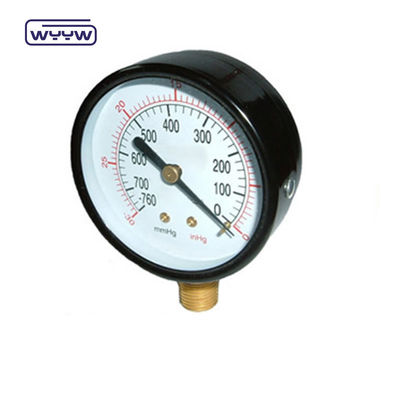
Choose negative pressure for general pipeline, tank, and low-vacuum equipment monitoring, as it directly reflects pressure deviation against the workshop’s ambient atmosphere. Opt for vacuum degree when calibrating high-precision vacuum gauges, vacuum coating machines, or scientific experimental devices, where absolute pressure data is required for accurate technical calculations.


Key Takeaway

To sum up: Negative pressure is a gauge pressure reading referenced to atmosphere with negative values, while vacuum degree is an absolute pressure measurement starting from absolute zero with positive values. Mastering these differences helps you read vacuum pressure gauges correctly and avoid measurement errors in industrial production.


Get in touch with us
Contact Person : Abby Yang
Tel : +8615153253081
Characters Remaining(20/3000)